
For organizations, implementing a good data strategy can be a pretty big task. According to Dataversity, only 30% of companies have a clear organizational data strategy. Data strategy as defined by Gartner is a highly dynamic process employed to support the acquisition, organization, analysis, and delivery of data in support of business objectives. Organizations wanting to move towards a more data-driven culture can do so by starting with a data strategy. Having a data strategy is the foundation to all things data in your company. Dataversity lists some characteristics of a strong data strategy:
- A strong Data Management vision
- A strong business case/reason.
- Guiding principles, values, and management perspectives
- Well-considered goals for the data assets under management
- Metrics and measurements of success
- Short-term and long-term program objectives
- Suitably designed and understood roles and responsibilities
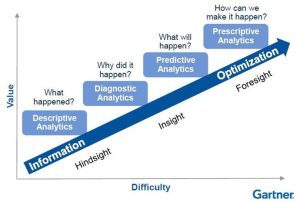
Overall, a good data strategy is one that unites departments throughout the organization and aligns them to meet business goals. Without strong analytics capabilities, a data strategy can not survive on it’s own. Garter provided an Analytic Ascendancy Model that shows the goal of moving from descriptive analytics to prescriptive analytics and by creating decisions using foresight instead of hindsight.
Understanding the seven data lifecycle stages is also important when implementing a data strategy:
- Plan: The company creates a roadmap based on an organization’s Data Strategy to guide data activities through the other lifecycle stages.
- Design & Enable: An organization purchases or develops a data solution and deploys it.
- Create/Obtain: A business inputs data in the system.
- Store/Maintain: The firm keeps the data in one or more systems to retrieve for usage. In addition, it performs maintenance on the data to keep it business-ready.
- Use: A company does something with the data to complete business objectives.
- Enhance: An organization makes its data more findable.
- Dispose of: A firm purges the data from its data systems.
To implement your strategy across the data lifecycle Dataversity recommends building a data culture, measuring and testing data activities, focusing on interoperability, and aligning your data lifecycle activities through business use cases.