Brand vs. Performance Marketing: What Four Marketing Leaders Told Their Peers
Four marketing leaders from four very different businesses sat on one stage in Houston and landed on the same fix: stop treating brand and performance as separate jobs. They also agreed on something else. None of them said they’d fully solved it.
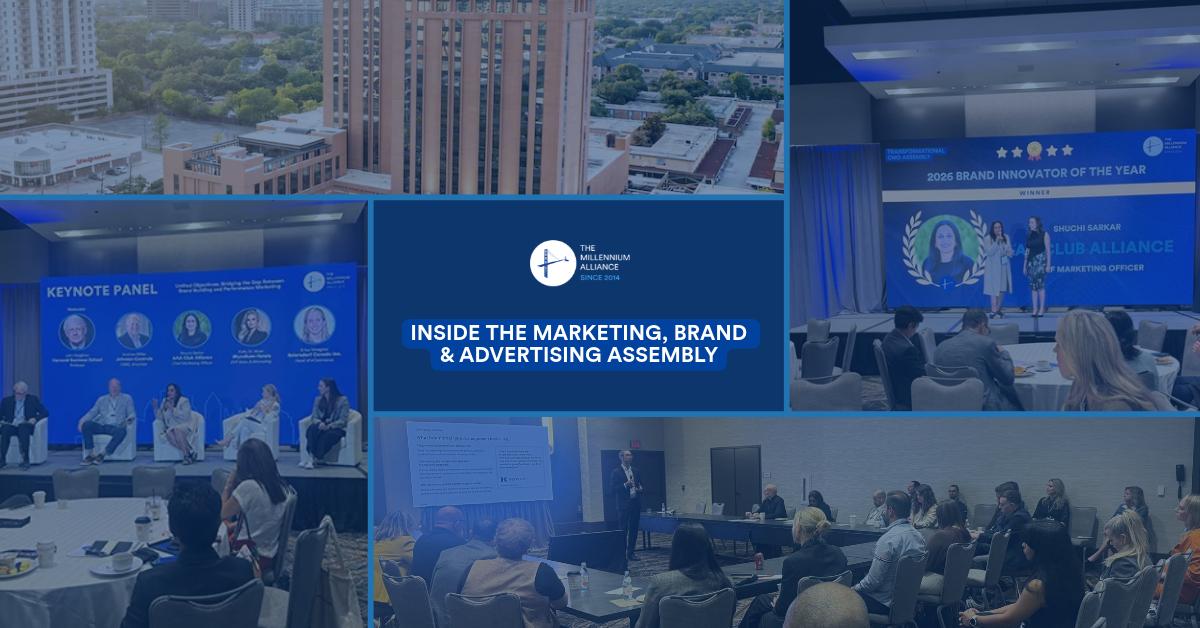
The conversation was our Day 2 keynote panel at the Transformational CMO Assembly, “Unified Objectives: Bridging the Gap Between Brand Building and Performance Marketing.” It was moderated by John Deighton, Professor at Harvard Business School, and the panelists were all delegates: Shuchi Sarkar, Chief Marketing Officer at AAA Club Alliance; Andrew Miller, CMO, Americas at Johnson Controls; Kelly St. Myer, EVP Sales & Marketing at Wyndham Hotels; and Erica Meagher, Head of eCommerce at Beiersdorf Canada Inc. A membership organization, a hotel company, an industrial manufacturer and a consumer goods portfolio. Same problem.
The same idea ran through the workshops and keynotes around it: marketing’s credibility now depends on connecting the pieces. That means the funnel, the org chart, the data and the brand’s promise.
Key takeaways
- Boards want one number from marketing: revenue and growth. Separate brand and demand scorecards make that number harder to deliver.
- The panel described the same fix in different words: one owner or one north star for the full funnel, and one shared scorecard with sales.
- Attribution models help, but they’re a guide. They’re only as good as the data and shared definitions behind them.
- AI is now part of how people find brands, so consistency across Google, social, Reddit and your own site is a trust signal for machines as well as people.
What delegates told us before they arrived
Before the Assembly, delegates in the CMO track filled out a needs assessment where we asked for their department’s key objectives.
Growth led by a wide margin. About two in three named revenue and growth as an objective, and it was the top answer at every seniority level. After that, the list was crowded:
- About four in ten named digital, martech and systems integration.
- About one in three named AI adoption, and about the same share named efficiency and operating model changes, or customer engagement and retention.
- About three in ten named launches and go-to-market.
- Just over one in four named brand awareness and preference.
- About one in six named measurement.
Two things stand out. Most delegates weren’t picking one priority: about seven in ten named three or more areas. And AI rarely stood alone. Only a couple of delegates listed it as their only objective. It showed up next to growth, efficiency and customer goals. The Day 2 panel started with growth, so we will too.
You’re being measured on one number
The panel’s starting point was that the boardroom wants revenue growth from marketing and not much else. Shuchi Sarkar put it bluntly:
“Your boardroom asks you for only one measurement, and that is the revenue impact and growth that marketing is delivering.”
She added that many business leaders no longer have patience for the traditional metrics. “Everybody wants to know what’s your revenue growth and what have you impacted at the end?”
Andrew Miller’s team at Johnson Controls works to a short list of four metrics: dollar value of revenue, dollar value of pipeline, number of opportunities created, and number of leads generated. “Those are the four things.”
A marketing leader at a global technology company said the same shift in a workshop discussion: “Marketing is moving beyond generating leads and influencing revenue. The question now is how marketing can have a seat at the table when it comes to generating revenue.”
Why it matters for a CMO: if your scorecard has twelve metrics and your executive committee reads four, you’re debating in a language they don’t speak. The panel’s answer was to pick the numbers your leadership team already cares about, then build the brand case in those terms.
Brand and demand shouldn’t have separate owners
When Sarkar took the CMO job at AAA, she made it a condition that brand and demand generation sit together. In her words, “do not separate brand and demand generation,” because splitting them creates different KPIs, with brand watching awareness and consideration and demand teams measured on the funnel.
Miller was candid that Johnson Controls isn’t there yet. “We do not have this right, by the way, yet,” Miller said. The brand team sits in Zurich, creative in Ireland and digital in Milwaukee, while Miller runs Americas campaigns from Chicago. The data points to a cost of the split: “The effectiveness is going down on lead gen, which means we’re not doing enough on the brand side and measuring the right things.”
What do you do when you can’t change the org chart? Erica Meagher’s answer was to find allies. If media is performing but product pages on Amazon are suppressed because of out-of-stocks, “that is burnt media budget.” Meagher’s prescription: set a shared north star in budget planning, meet regularly to course correct, and “find your champions within the organization.”
Sales is the other half of the handshake. Sarkar noted that in many organizations “there are no SLAs with sales, so marketing holds all accountability.” Miller’s team has a phrase for it, “There’s no daylight between marketing and sales,” and a monthly operating review where marketing reports on the same red-or-green template as every other function. Kelly St. Myer closed the panel on the same point: “if your sales and marketing team are having your meetings separately and you’re not coming together as a unified team, how are you going to be successful?”
In the workshops, other delegates added that marketing’s scope is part of the problem. “Anything that’s not operations has somehow fallen into my organization,” said a technology marketing leader. “On one hand, it creates consistency across the brand, but on the other, the team is absolutely overwhelmed.” A digital leader at an energy company argued for a partner that doesn’t always get invited: “You have to bring IT people into marketing because you need to speak the language of IT to be successful.”
Attribution is a guide, not an answer
The panel treated attribution with healthy skepticism. St. Myer’s reminder was short: “just always remember that it’s imperfect.” Sarkar was more specific about why.
“I think that attribution models are as good as your data is. To be very honest, it’s garbage in, garbage out.”
She said they’re still worth having because they give you a guide, but “it’s ultimately up to you to take that final judgment call.” The risk is what gets funded when a model only rewards what’s easy to measure. Direct conversion is the easiest to count, and she described what happens if that’s all you fund: “You can keep on taking out water from the well, but ultimately the well will dry.” In her telling, the rainwater that refills the well is spending on brand and retention, which is harder to attribute and still has to be funded.
The workshops took the “garbage in” point further. The energy-company leader offered a rule for the human side: “AI can get you 80% of the way there, but you still need the human component to verify the results and make sure they’re right.”
One practical takeaway: when someone shows you an attribution model or an AI tool, ask what data it can see. Then ask how it would hold up in front of your CFO.
Trust counts twice, and AI is checking
Kelly St. Myer’s best-remembered point was about how brands get found. To show up across large language models, “consistency, trust” is the thing. St. Myer named three places that matter: Google, social media and Reddit. AI agents are searching all of them, and if the story doesn’t match, they’ll move on.
“If your messaging isn’t the same exact way from social media to Reddit to Google to your website, they’re going to think, ‘I can’t trust you.'”
A university CMO sharpened the point in a workshop on public confidence: “Your brand’s experience is no longer just a narrative, but structured, objective data. Brand promises must match operational truth.” AI won’t take your word for it. “We can’t say we’re something if we’re not, because AI is going to test those claims against observable performance.” A technology marketing leader noted who the audience now includes: “One of the most blurred lines we’re seeing is that marketing is now being tasked with influencing not just people, but bots and AI agents.”
For CMOs doing AI search visibility work, that suggests a simple audit: read your own brand across Google results, social profiles, Reddit threads and your website, then check whether a stranger would think it was one company.
What two keynotes added
Our Transformational CMO Assembly is a two-day, peer-led gathering for senior marketing leaders. Houston’s program mixed AI Power Hour roundtables of 20-30 peers, and a number of 30-minute workshops, one-hour roundtables and a keynote panel. Two keynotes on Day 1 added the data and creator angles.
Klaviyo: fix the silos before you add more agents. Mike Lisavich, Senior Director of Product Management at Klaviyo, said the best-in-class tools marketers bought over the last decade now each come with their own agent, and each one “only knows what it knows.” His advice: “The question really isn’t at this point, what is the best tool anymore? In my view, it is whether or not they share what they know because that’s going to make them effective.” He also urged marketers to measure results, not hours saved, and to keep humans on the creative. Fully autonomous agents messaging customers is “a little bit too black box for me at the moment.”
Later: the journey isn’t a funnel. Nicki Seaborn, Head of Creator Product at Later, said “there is no linear journey today between awareness, consideration and purchase,” because many purchases now start with AI research. Seaborn sees the next stage for brands as the point where “your performance and your awareness and your social team budgets will start to sit together,” which is the panel’s brand-and-performance point from the creator side. Seaborn’s advice on creators: don’t over-restrict them. “Just tell them three things they can’t do” and let them do the rest.
Our 2026 Brand Innovator of the Year
Shuchi Sarkar had a full day. After speaking on the panel that morning, she was announced at the Day 2 lunch as winner of The Millennium Alliance 2026 Brand Innovator of the Year Award.
It’s a fitting win. Sarkar has more than 20 years of global marketing leadership across B2C, B2B and B2B2C businesses, from scrappy startups to Fortune 50 companies. She has transformed legacy systems, scaled AI-driven operations and built high-performing teams across the U.S., EMEA, APAC and India. She is both bold and grounded, and her panel comments showed why.
She talked about AAA’s push to be more than the tow company people call when the car breaks down, and she was frank about the risk of standing still: “we’re losing relevance with the younger audience.” She said she made the case with evidence. “I’m a big believer in pilots… give me some money, low risk. I’ll do a pilot and prove it out.”
Congratulations to Shuchi, and to every nominee.
What to take back to your team
Nobody on the panel offered a framework. They offered habits for connecting the pieces, and they’re cheap to try:
- Ask who owns the full funnel. If brand and demand report to different leaders, agree on one shared north star and one scorecard, even if you can’t merge the teams.
- Cut your scorecard to what the executive committee reads. Then show how brand work moves those numbers.
- Pilot before you pitch. Small, low-risk tests with a clear before-and-after are easier to fund than a big new strategy.
- Treat attribution as a guide. Agree on shared definitions and clean the data first, then use judgment on top of it.
- Check your claims against reality. AI can test what your brand says against what customers experience.
These are the questions we build our Assemblies around. Our Houston panelists were delegates themselves, and that’s the model: practitioners on stage, peers in the room who have the same problem and a different business. We’ll take them up again at our Transformational CMO Assembly in Charlotte on February 3-4, 2027, with workshops on how CMOs build credibility at the executive table, balancing long-term brand building with short-term performance, and keeping your brand discoverable in an AI search world. Come with your own questions. Details are at mill-all.com.
About The Millennium Alliance
Founded in 2014, The Millennium Alliance is a premier technology and business advisory firm dedicated to transforming the digital enterprise. By bridging the gap between enterprise C-Suite leaders and their technology partners, we’ve become a global leader in corporate-level executive education and peer-to-peer engagement. Learn more at mill-all.com.