Which Town Do You Save? AI Security Lessons from Barcelona’s CISOs and CIOs
Jon Staniforth, CISO at EDF Energy, has a way of explaining AI-speed risk to his CEO. When a forest catches fire, the brigade picks which town to defend. “They choose which town to put the fire brigade into, and knowing the other town in the same forest may burn, because if they actually spread their resources, both towns will burn.”
He told that story on the keynote panel at our European Transformational CISO and Digital Enterprise CIO Assemblies in Barcelona. It lands because it’s uncomfortable. You can’t defend everything at AI speed, so you need to decide in advance what you’re willing to lose.
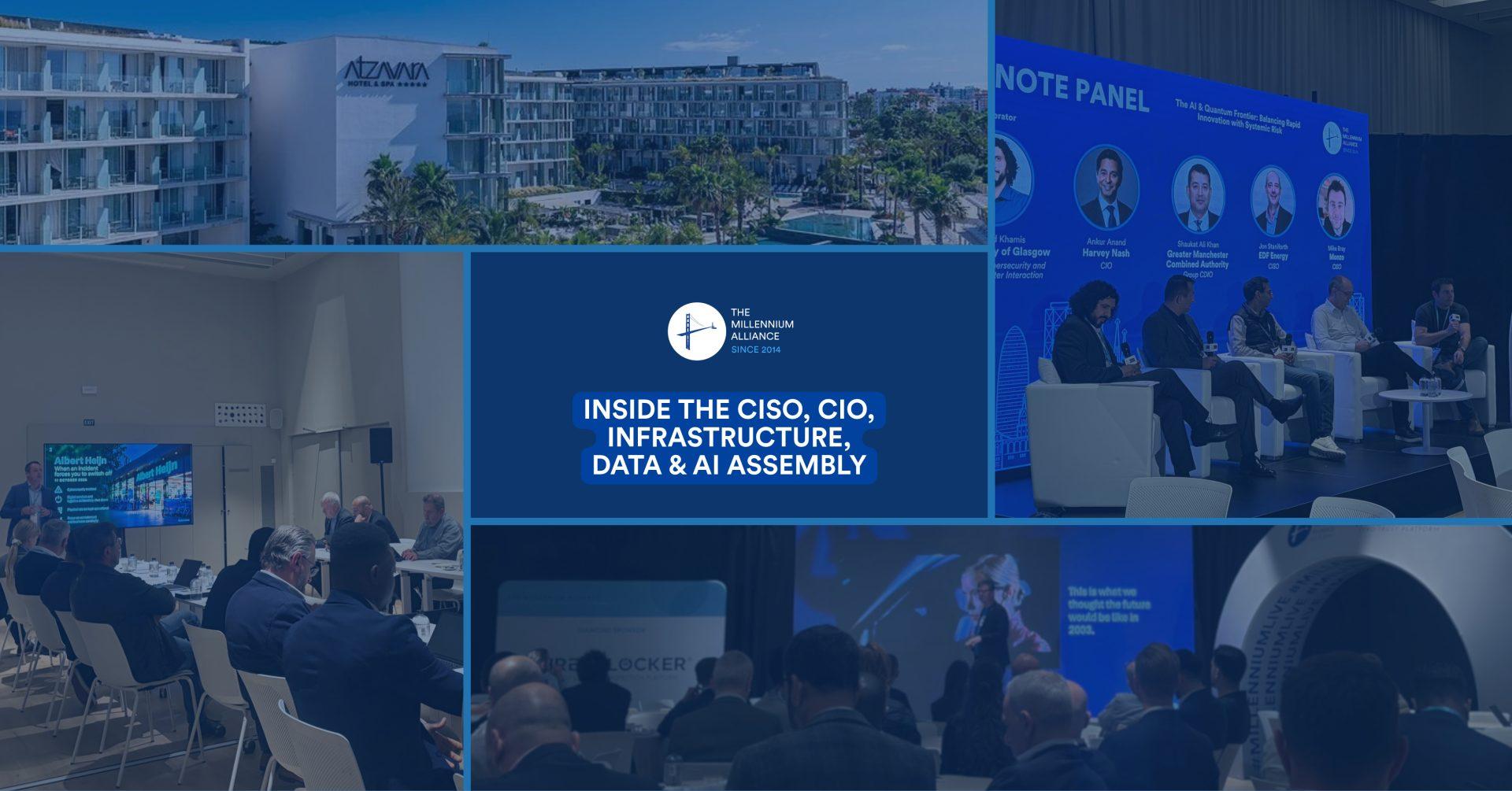
Staniforth shared the stage with Mike Bray, CISO at Monzo, Ankur Anand, CIO at Harvey Nash, and Shaukat Ali Khan, Group CDIO at Greater Manchester Combined Authority. Mohamed Khamis, Professor of Cybersecurity and Human-Computer Interaction at The University of Glasgow, moderated.
The short answer: AI hasn’t changed what good security looks like. It’s changed how fast things go wrong. The leaders on stage said the way through is to decide what matters most before an incident, find out how your own people are using AI, and fix the process, not just the tool.
What delegates told us before they arrived
Ahead of every Assembly, we ask registered delegates to describe their department’s objectives. On the security side, just under half named AI. About four in ten named governance and risk, and just over a third named regulation, with NIS2, DORA and ISO 27001 coming up by name. About three in ten named detection and response, and about one in six named third-party risk.
On the technology side, about two in three mentioned AI. Roughly three in ten named data, transformation or platform programmes, and about one in four named efficiency or cost. Only about one in ten named security or regulation.
Same topic, different questions. Security leaders arrived asking how to govern AI. Technology leaders arrived asking how to scale it.
Which parts of your business can you afford to lose?
Staniforth started from an honest place. “The tools aren’t even there to help us do this in real time, but our job is to protect the business, or the people in it, or the services that it provides.” So cyber leaders have to start changing how the business runs while the tools catch up. That means asking leadership a hard question: “Do you know which parts of your business you’re prepared to lose and prepared to save?”
He gave an example from the Marks and Spencers incident response. By his account, the company had 150,000 suppliers and worked out that only 38 mattered, but it took three weeks to get there.
Suppliers came up from other seats too. Khan said the question used to be what product you were buying. Now his team also asks how it was built and what its supply chain looks like, which he called “secure by design.”
Deciding who can act is part of the same job. In the opening keynote, Eoin Mcgrath, Solutions Engineer at ThreatLocker, warned against response plans that stall because “you need approval from the CIO who’s gone skiing.” His rule: “better downtime of six hours and a false alarm than downtime of six weeks because you didn’t react fast enough to a potential breach.”
Is the bigger risk using AI, or not using it?
Bray started with speed. Everyone’s focused on AI finding vulnerabilities, he said, but finding them is the easy half. A lot of organizations are “not geared up to deal with patching vulnerabilities.” Then there’s usage. Every SaaS vendor now has AI components, and “we don’t actually see where they’re using it and how they’re using it.”
Then came the line people kept coming back to. “I actually think there’s a real risk that the gap widens because we’ve got attackers using AI all over the place.” Security teams, Bray said, are “so inherently trained to think about the risks associated with things” that they weigh them too heavily against the benefits. He also noted, “the risks involved in a lot of cases are no different to how you would expose data or deal with things through other systems already day to day.”
Khan’s answer was to keep moving while building the rules. His team pilots in an innovation lab on defined groups, then rolls out as it learns. “Cybersecurity or security is not to put an extra obstacle on innovation, but how we can enable innovation.”
The guardrails still matter, and the opening keynote showed why. Mcgrath asked a free chatbot for code to steal files and was refused. He asked for the same thing framed as backing up data to the cloud, and got it. “It’s all about intent and it’s all about how these things get framed.” In another demo, an agent on his workstation wiped a documents folder because it “had all of the same permissions that I had.”
Why start on quantum before there’s a threat?
Quantum was the moderator’s question, and Anand reframed it. “It’s basically a management problem.” State actors are already collecting encrypted data to read once quantum computers arrive, he said. He said the UK’s NCSC wants discovery and readiness plans by 2028, priority systems migrated by 2030 and the work finished by 2035.
He also compared the job to a past migration: “Windows XP migration took almost 15 years, right? This is far more complex than that.” His diagnosis: “It’s a lack of awareness at the board.”
The others weren’t sure the board was the right place to start. Bray said that if you took quantum to your board, “they would probably sit back and say, ‘Why are you talking to me about this?'”
Bray and Staniforth both offered a simpler way in. Bray said that if someone has stolen your encrypted data already, “that’s already a security problem you have.” Staniforth took it a step further. If the data’s already gone, “surely I have to plan to respond to an incident that might happen sometime in the next three years.” So the work fits into what you’re already doing. Know your assets, know where your crypto sits, and practice handling more than one incident at a time. Then you don’t need a separate pitch. As Staniforth put it, “I don’t need to tell the board about that. It’s my job anyway.”
Who puts their name on it?
Staniforth thinks the real prize is redesign, not automation. “Many of our business processes existed to glue together bad technology.” In one company he saw 28 approval steps to hire someone, when three people were really needed: finance, HR and the line manager. Redesigning it took a year across functions. Cyber drove it because he was trying to hire 100 cyber people in a year. His view: “cyber leaders are now actually the people that have to help businesses change, not just sit in a corner as part of IT.”
Skipping that step is expensive. He knows of a couple of big AI projects that wrote off £10 million because nobody understood the business objective. “People and process are actually the problem, not the technology.”
Anand brought the CIO view. Citizen developers on Copilot Studio and other agentic platforms are turning ideas into scalable solutions, he said, and IT adds governance, control and security once an idea proves itself.
Khan kept it simple. “AI can give everything, but it’s us who is going to put our names into it.”
What to do next
If you’re a CISO, write down the town you’d save. Take that list to your CEO and your CIO before an incident, not during one. If you’re a CIO, find out where AI is already running in your business, and who can approve a shutdown when you’re not reachable.
That’s the seat at the table Gustavo Maniá, Information Security and Risk Manager (Regional CISO) at HEINEKEN, asked for when he accepted the 2026 EU CISO of the Year award at the Assembly. “Let’s bring cybersecurity to the tables.”
We’ll keep the conversation going at our European Transformational CISO Assembly and European Digital Enterprise CIO Transformation Assembly in Amsterdam in May 2027. Details are at mill-all.com for the CISO Assembly and for the CIO Assembly.
About The Millennium Alliance
Founded in 2014, The Millennium Alliance is a premier technology and business advisory firm dedicated to transforming the digital enterprise. By bridging the gap between enterprise C-Suite leaders and their technology partners, we’ve become a global leader in corporate-level executive education and peer-to-peer engagement. Learn more at mill-all.com.